
Understanding ring metals — 14K vs 18K vs platinum
Yellow gold, rose gold, white gold and platinum — how they differ in strength, color, care, and which pairs best with your stone.
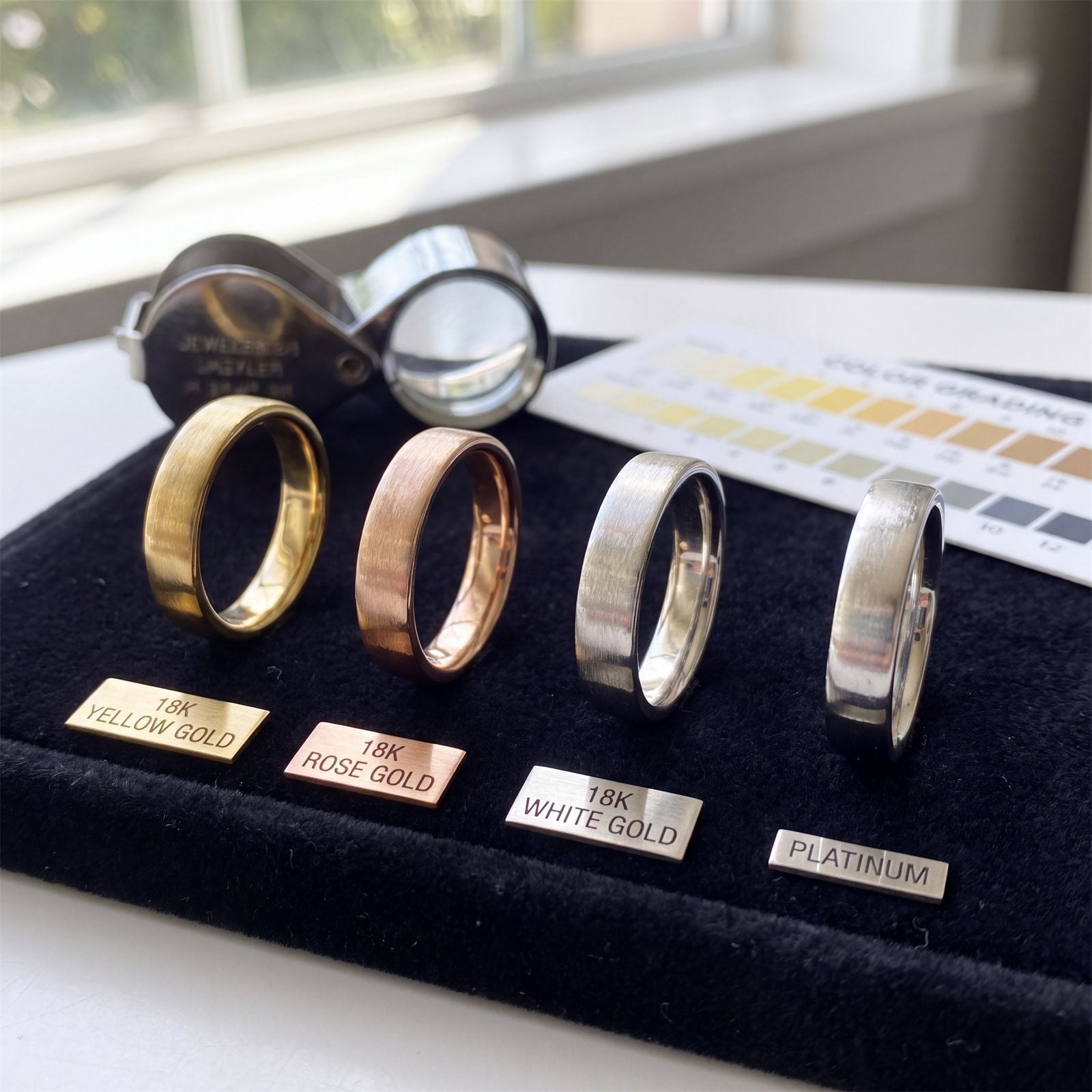
Mercury & Sol pieces are made in gold or platinum. Gold comes in three colors and two purities; platinum is a single, naturally white metal. The choice affects the color of your piece, how it wears over the decades, and how much upkeep it asks of you.
What does karat mean?
Karat measures gold purity. Pure gold (24K) is too soft for jewelry, so it’s alloyed with stronger metals. Higher karat means more gold and richer color; lower karat means more durability.
| Karat | Gold content | Character |
|---|---|---|
| 18K | 75% gold | Rich color, luxury standard, slightly softer |
| 14K | 58.3% gold | More durable, slightly lighter color |
| 10K | 41.7% gold | Most durable, least saturated |
Mercury & Sol uses 14K and 18K gold, plus platinum. 14K offers the best balance of durability and beauty for daily wear. 18K is available for those who prefer a richer gold tone. Platinum is offered on white settings as its own metal — not a karat of gold.
Yellow gold
The classic warm tone from pure gold itself. Hypoallergenic and requires no rhodium plating. Pairs beautifully with warm-toned gemstones.
Rose gold
Gets its blush-pink warmth from copper in the alloy. Romantic and increasingly popular. Creates beautiful contrast with green stones like emerald.
White gold
Created by alloying with white metals, then coated with rhodium for a bright silvery finish. Enhances diamond brilliance. Re-plating needed every 1–2 years.
Platinum
Platinum is not gold at all — it is a separate precious metal, and the only one of our options that is naturally white the whole way through. Our platinum is 950 platinum: 95% pure, compared with 75% for 18K gold and 58.3% for 14K. Because the whiteness is intrinsic to the metal rather than a rhodium coating, a platinum ring never needs re-plating. It looks the same on year twenty as it did on day one.
Platinum is also noticeably denser. The same ring weighs roughly 60% more in platinum than in 14K gold, which is immediately obvious when you pick it up — many people choose platinum precisely for that substantial feel on the finger.
How platinum wears
Gold and platinum age differently, and this is the real deciding factor for most people. When gold is scratched, a small amount of metal is lost. When platinum is scratched, the metal is displaced rather than removed — it moves aside instead of wearing away. Over years this builds a soft matte sheen called a patina. Some owners love it and leave it; others have the piece polished back to a bright finish, which a jeweler can do any number of times without thinning the metal.
That same property makes platinum the most reliable metal for prongs. Since it deforms instead of wearing thin, platinum prongs hold a center stone securely for longer than gold prongs of the same size — which is why platinum is a common choice for engagement rings that will be worn every day for decades.
Sensitive skin
950 platinum contains almost no alloy metals, and no nickel at all. If you react to costume jewelry or to some white gold, platinum is the safest choice we offer.
Gold vs platinum at a glance
| 14K / 18K gold | Platinum | |
|---|---|---|
| Purity | 58.3% / 75% gold | 95% platinum |
| Color | Yellow, rose, or rhodium-plated white | Naturally white throughout |
| Upkeep | White gold needs re-plating every 1–2 years | Never needs plating |
| Weight | Lighter | About 60% heavier |
| When scratched | Metal is lost | Metal is displaced — forms a patina |
| Prong security | Good — check annually | Excellent — wears very slowly |
| Sensitive skin | Yellow gold is safe; white gold may contain nickel | Nickel-free |
| Price | Most accessible | Premium over gold |
Choosing between white gold and platinum? They look nearly identical when new. Pick white gold if you want the look at the lower price and don’t mind a re-plate every year or two; pick platinum if you would rather pay more once and never think about maintenance again.
Which metal for which stone?
| Stone | Recommended metals |
|---|---|
| Diamond | All metals — universally versatile |
| Pink sapphire | Rose gold enhances warmth; white gold creates contrast |
| Blue sapphire | White gold for classic; yellow gold for regal |
| Emerald | Yellow gold traditional; rose gold for modern warmth |
| Ruby | Yellow gold for classic; white gold for contemporary |
| Padparadscha | Rose gold mirrors the stone’s warmth beautifully |
Anywhere white gold is recommended above, platinum works equally well — the two read almost identically once set. The difference is upkeep and feel, not appearance.
Continue learning
Lab-grown stones
Gemstone education
Buying guides
Ring knowledge